 Contact Support
 Sign In


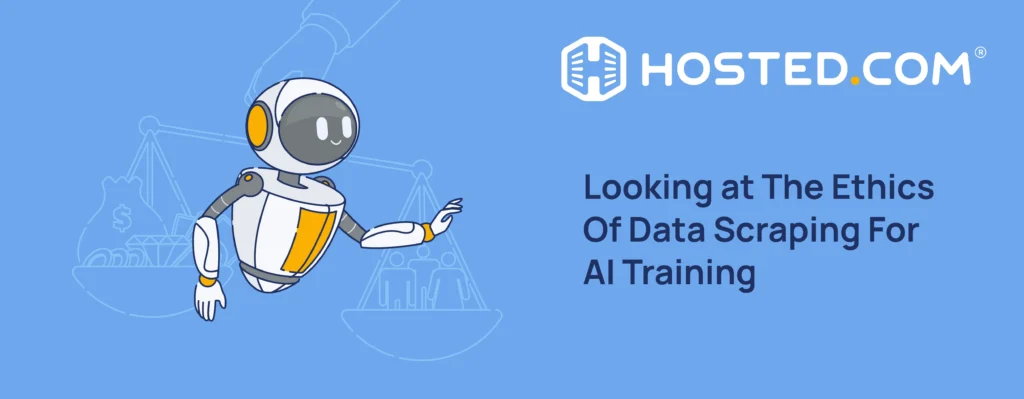
Artificial intelligence (AI) has become an everyday tool for most people. From chatbots to fraud detection and content creation, AI models have changed how businesses operate online. At the center of this is massive amounts of training data. To meet the demand, AI companies rely on data scraping to collect as much information as possible from websites, social platforms, and other online sources. While it may seem efficient and innocuous, it raises ethical questions around how it’s done. In this guide, we explain what data scraping means, the ethical implications involved, how it affects websites and Web Hosting, and what could happen when the data well runs dry.
KEY TAKEAWAYS
- AI model training requires vast quantities of data, but it amplifies ethical and legal issues about data scraping.
- Limited transparency in machine learning makes accountability and trust more difficult to achieve in AI-generated results.
- The ethical implications of data scraping extend beyond data collection, requiring fairness, transparency, privacy protection, and legal awareness.
- Hosted.com® helps protect your website’s performance, stability, and user experience from AI crawling issues.
TABLE OF CONTENTS
What is Data Scraping in Machine Learning?
The Machine Learning (ML) methods used to train AI models require vast, varied datasets to recognize patterns and make predictions. One of the main methods AI companies use to collect this information is through data scraping.
Data scraping refers to using automated AI crawlers or bots to collect large amounts of data from websites, social media platforms, blogs, User-Generated Content (UGC) and more. They systematically browse the web, collect content, and store it for processing, which then becomes part of the training data used to teach models.
In ML, having a wide variety and amount of data helps improve results. When AI models are trained on larger, more diverse datasets, they tend to generalize better, recognize patterns, and handle task automation. Scraping does this at a scale which manual collection cannot match, making the process much faster. However, this comes at a cost. When datasets are scraped en masse, they can sometimes contain outdated information, copyrighted content, personal data, or biases. Since machine learning algorithms and applications operate on such a massive scale, it can be hard to monitor, and these issues might be unintentionally missed and absorbed into the AI models.
The Black Box Problem
This brings us to one of the biggest challenges in machine learning and training data: the black box problem. Many AI models make decisions in ways that can be difficult to understand; not even the developers who built them can explain exactly how or why they reached that conclusion. When training data is scraped from countless unknown sources, developers might not even know where specific information came from, if it is accurate, or if it contains biases.
Related Blog: AI Models and Machine Learning Training Data Gathering
As a result, AI models can sometimes generate outputs that are hard to trace, verify, and find how those sources influenced them, complicating accountability and transparency.
It usually happens with Deep Learning (DL), which uses Neural Networks inspired by the human brain. DL uses billions of internal parameters, each one tuned slightly to help models recognize patterns.
The data also passes through thousands of layers, each of which slightly modifies it. By the time it reaches the end, the information has become complex mathematical abstractions. Models can also use “illegal” shortcuts without the creators knowing.
This ultimately limits transparency and makes it difficult (if not impossible) to correct or remove the problematic data that causes hallucinations or completely wrong results.
The Black Box problem isn’t just a technical mystery; it has massive ethical and safety implications. If a model makes a mistake or we don’t know why the model said something, how do you fix it if you don’t know what caused it or where in the chain it happened?
Bias in AI Models
This is a big one. Bias is one of the most well-documented risks associated with training data in machine learning. If AI models are trained on content that contains (unintentionally or otherwise) inequalities, stereotypes, or misrepresentations, those biases become part of their outputs.
You’ve likely noticed that web and social content is not neutral. Bias enters AI models via imbalanced datasets, skewed samples, and feedback loops that reinforce existing patterns in ML.
If data scraped from sources overrepresents certain groups while underrepresenting others, AI models can internalize and amplify those biases, leading to discriminatory or unfair results.
One of the most cited examples of bias is the Amazon AI recruiting tool, designed to automate the screening of job applicants. The problem arose because it was trained on historical resumes submitted during a time when the tech industry was mostly male. This led to the AI “learning” that being a male was a prerequisite for being hired.
As a result, the model began penalizing and downgrading resumes that included the word woman or women. Despite attempts to patch the error, it continued to favor male candidates, eventually forcing Amazon to scrap the project because it could not guarantee gender neutrality.
According to Dr Timnit Gebru, founder and Executive Director of the Distributed AI Research Institute (DAIR).”We’re seeing a kind of a Wild West situation with AI and regulation right now. The scale at which businesses adopt AI technologies isn’t matched by clear guidelines to regulate algorithms and help researchers avoid the pitfalls of bias in datasets.”
The “Always Right” Design
Speaking of bias, you’ve probably noticed how many AI models are extremely friendly, agreeable, and tell you you’re always right, within their safety guardrails to prevent prompt infection attacks and jailbreaking. This isn’t an accident; it’s their default setting, often encouraged by numerical feedback rewards for user satisfaction.
While this makes them easier to use and engage with, it can also encourage over-agreement, confident-sounding errors, and give people the impression that their agentic AI tools are infallible and all-knowing. This “always right” design mindset can lead to over-reliance on AI models, causing people to take answers at face value without checking whether they are even correct or objective.
This can potentially cause less human judgment and critical thinking, because people start treating outputs as always correct without questioning, rather than fact-checking and considering whether the generated answer is even logical.
Privacy, Security, & Personal Data
Scraped data can include sensitive and/or personal information, even when anonymization techniques are applied, sometimes collected without knowledge or consent, even if the source is “publicly accessible”, like social media or forums, or emanates from private medical or financial records. Additionally, AI crawlers don’t stop at scraping web content; bots can also affect forms, login pages, and checkout metadata.
This means names, email addresses, comments, images, and even your location can all end up in training datasets, creating new opportunities for fraud, account takeover, and data theft. An audit of a large, scraped AI dataset found that 0.1 % of samples still contained identifiable personal information despite filtering.
As you can imagine, this raises various serious privacy and security concerns. Once personal data is stored or incorporated into AI models, removing it is extremely difficult. Storing large, scraped datasets can also create security risks if models and their core prompts are compromised or breached, especially with the new breed of AI cyberattacks, which are becoming increasingly sophisticated.
This is ironic.
Many privacy advocates believe that just because data is publicly available doesn’t necessarily mean they agree it should be used for commercial AI training. This perspective highlights the importance of respecting individual privacy and ensuring clear consent.
Respecting user privacy requires strict data governance, anonymization practices, and responsible storage, all of which must be considered when training AI models.
Is Web Scraping Legal?
Now for the legal stuff. Data protection laws, copyright disputes, and emerging AI regulations increasingly affect how training data can be gathered and used. It’s also becoming a big part of ethical AI training and development, and begs the question: Is web scraping legal?
The central question is whether training an AI on copyrighted but publicly available data, such as news articles and UGC, is fair use (turning it into something new) or infringement (creating a different but similar version of the original).
Ed Newton-Rex’s talk titled “How AI Models Steal Creative Work — and What to Do About It” at TEDAI San Francisco on October 22, 2024, sums this up quite nicely: “Right now, many AI companies train on creative work they haven’t paid for or even asked permission to use. This is unfair and unsustainable.”
Because of this uncertainty, there’s been a massive shift toward companies like OpenAI and Google signing licensing agreements. This means they are paying publishers for access to high-quality content and data, rather than relying solely on a fair-use policy, which, in theory, works well for everyone involved. Creators get paid, AI companies don’t get sued.
However, the legal environment around AI training is very much a work in progress due to the rapid advancement of AI and regulations needing to constantly catch up. Rulings against AI developers could increase pressure for licensing regulations or other forms of compensation for content creators and businesses, including potential limits on what models can do.
In the January 6, 2026, Baker Donelson AI Legal Forecast, authors said: “Organizations should audit their use of generative AI tools to distinguish between input risks from data scraping and output risks from generating infringing content.”
Multiple companies are currently in the middle of major, high-profile legal battles that are reshaping the laws regarding AI and the gathering of training data. For example, there’s the the Reddit vs Perplexity case, in which Reddit filed a major lawsuit against Perplexity AI and several third-party scraping companies.
Reddit’s legal team accused Perplexity of scraping content indirectly via Google search results to circumvent its inability to crawl it directly, allegedly because Perplexity has no licensing agreement in place with Reddit.
To prove this, Reddit claimed it published a test post invisible to normal users but crawlable by search engines. Within hours, the hidden post’s content appeared in Perplexity’s AI answers.
It’s also worth mentioning that 79% of the top 100 news websites in the US and UK currently block at least one AI training crawler (GPTBot, ClaudeBot, PerplexityBot).
This brings us to a major trend in 2026: the use of unidentified user agents. These crawlers do not declare themselves as AI, bypassing AI-specific blocks and rendering robots.txt files (directives that tell bots what they can and can’t crawl on a website) mostly ineffective. This is extremely unethical.
A good example of this in action was in the second quarter of 2025, when 13.26% of AI bot requests were found to be explicitly ignoring robots.txt directives.
Impact of AI Crawlers & Web Hosting Performance
Now that we’ve covered the ethics and legality around data scraping, there’s also a technical side to things: the impact of AI crawlers on website performance when they scrape data. Traffic from AI bots grew by roughly 49% from late 2024 to early 2025, showing how quickly companies are adopting automated scrapers to gather content.
AI crawlers operate at scale, sending huge amounts of requests quickly and repeatedly (up to thousands per second) to websites. Unlike traditional search engine bots, these crawlers are much more aggressive, collecting entire pages, images, videos, and structured data, placing strain on web hosting resources (CPU, RAM, bandwidth) and infrastructure.
Excluding major search engines like Google, AI crawlers now account for 4.2% of all global HTML request traffic through AI “user action” crawling, where bots simulate human behavior to scrape data. This increased by 1,500% during 2025, according to a report by Cloudfare.
This uncontrolled AI bot traffic can slow page loading speeds and even cause complete crashes.
As a website owner, you can sometimes mitigate the effects by using rate limiting, crawl directives in robots.txt files, or setting server-level firewall rules. The downside is that you risk legitimate traffic being unable to access your site or reduced visibility in search results, because safe crawlers can’t access or index your pages if you don’t configure things correctly.
On the plus side, the correct hosting can go a long way toward keeping your website up and loading fast.
With Web Hosting from Hosted.com®, we’ve designed our server environment to protect you from malicious requests and maintain performance and uptime, even during bot-generated spikes.
In addition to cutting-edge LiteSpeed server performance and caching software, we’ve integrated real-time server monitoring, intrusion detection, and machine-learning-driven protection powered by Imunify360 and Monarx. These systems help identify and block malicious activity, including suspicious automated requests by AI crawlers, before they can affect your site.
Lastly, all our cPanel Web Hosting plans let you manage traffic, configure access rules, and monitor server resource usage from a single control panel, giving you more control over how bots and automated crawlers interact with your site.
![Strip Banner Text - Hosted.com keeps your site fast & safe from harmful traffic [Learn More]](https://www.hosted.com/blog/wp-content/uploads/2026/02/data-scraping-04-1024x229.webp "Hosted.com keeps your site fast & safe from harmful traffic [Learn More]")
How to Install an SSL Certificate on Your Website
VIDEO: How to Install an SSL Certificate on Your Website
FAQS
Why do AI models rely on data scraping?
AI models need large, diverse datasets to recognize patterns and make accurate predictions. Data scraping provides scalable access to online information.
Is data scraping always unethical?
No. Data scraping can be ethical when it respects privacy, legal boundaries, and responsible data use principles.
How does scraped data introduce bias into AI models?
Scraped data may reflect societal imbalances or limited perspectives, which AI models can learn and amplify.
Can websites block AI crawlers?
Yes. Website owners can use technical controls and hosting tools to manage or restrict automated bot traffic.
What role do hosting providers play in ethical AI development?
Hosting providers help protect web performance, security, and availability while managing the impact of AI crawlers on infrastructure.
Other Blogs of Interest
– AI Website Builders – Sacrificing Creativity For Speed
– Top 12 AI Tools For Small Business And Startups
– Giving AI Access To Your Personal Data – The Risks Of Agentic AI
– AI Cyber Attack Guide – The Halloween Version
– AI In SEO – How Artificial Intelligence Is Changing Search
- About the Author
- Latest Posts

Wayne Diamond, the founder and CEO of Hosted.com, has over 20 years of expertise in the domain name and website hosting industry.
Under his leadership, Hosted.com will work towards transforming the way SMEs, entrepreneurs, freelancers, and established enterprises of all sizes manage their domain names, website and WordPress hosting, and online presence.