


 Contact Support
 Sign In
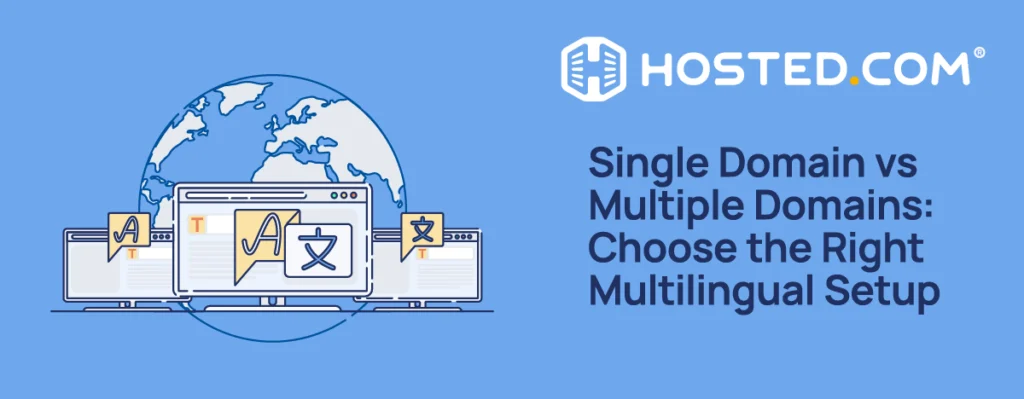
Should you use a single domain or multiple domains for your multilingual website? This question usually arises early in the planning process, and the answer isn’t the same for every business.
Your SEO goals, budget, team size, and expansion plans all play a role in this decision. A single domain keeps all your language versions in one place, while multiple domains provide each market or language with its own web address. Both approaches work, but they offer very different trade-offs in terms of cost, management, and search performance.
This guide explains those tradeoffs. You’ll learn how each structure works, what it means for your rankings, and which setup makes the most sense for your situation.
KEY TAKEAWAYS
- The multilingual website decision regarding single domain vs multiple domains should be based on your SEO goals, resources, branding needs, and expansion plans.
- A single domain is usually the better starting point for most businesses, because it consolidates SEO authority, costs less, and is easier to manage.
- Multiple domains work best when you have country-specific operations, separate teams, and the budget to maintain each site independently.
- Proper hreflang implementation and genuine localization matter more than the domain structure you choose.
- Your domain strategy is only as strong as the hosting, site management, and technical foundation behind it.
TABLE OF CONTENTS
Quick Answer: Should You Use One Domain or Multiple Domains?
For most businesses, a single domain with subdirectories or subdomains is the stronger starting point. It consolidates your SEO authority into a single property, costs less to maintain, and is far simpler to manage daily.
However, multiple domains make more sense when you’re running country-specific operations with separate teams, dealing with different legal or compliance requirements, or building distinct brand identities for each market.
When comparing a multilingual website single domain vs multiple domains setup, the deciding factors come down to your budget, resources, and growth plans. The rest of this guide explains exactly why and helps you figure out which side of that line your business falls on.
What is a Multilingual Website?
A multilingual website is simply a site that serves its content in more than one language. It lets visitors read pages, browse products, or access services in the language they’re most comfortable with.
What varies is the multilingual website structure behind it:
- Some businesses organize languages using subdirectories, for example: example.com/fr/
- Others use subdomains. Let’s say: fr.example.com
- Others go with entirely separate domains, for instance: example.fr
Each approach handles content, SEO, and management differently, which is why the structural choice is so important.
Why Multilingual Website Structure Matters for SEO & Growth
The way you organize your multilingual site affects more than just its appearance. It directly shapes how search engines understand and rank your content across different languages and regions.
Your international SEO domain structure determines whether Google treats your language versions as part of a single, cohesive site or as separate, competing properties. Get it wrong, and you could split your authority, confuse crawlers, or end up with the wrong language version appearing in search results.
Beyond SEO, structure also affects your visitors’ day-to-day experience. People trust websites that seem local. If your French audience lands on a page that’s clearly built for an English-speaking market, they’re more likely to leave than to convert.
There’s also the management side. Some setups are easy to maintain with a small team, while others demand dedicated resources for every market you serve. That’s why choosing the wrong structure early on can mean wasted budget and a painful website migration later.
The Main Multilingual Website Structures Explained
Before discussing the comparison, it’s important to understand the three most common setups:
- Single domain with subdirectories.
- Single domain with subdomains.
- Multiple domains country-code TLDs (ccTLDs).
Each one handles language versions differently, and the subdomain vs subdirectory multilingual SEO debate is a big part of this conversation.
Single Domain with Subdirectories
This is the most straightforward approach. You keep one domain and organize each language under its own folder.
For example:
example.com/en/ for English
example.com/fr/ for Frenc
All your content lives under the same roof, which means every page contributes to the authority of a single domain.
Single Domain with Subdomains
With this setup, you still have one root domain, but each language gets its own subdomain.
For instance:
en.example.com for English
fr.example.com for French
The brand stays unified, but search engines may treat each subdomain as a partially separate entity. That’s an important distinction regarding how your SEO authority is distributed.
Multiple Domains (Country-Code TLDs)
Here, each market or language gets its own standalone domain, typically using a country-code TLD.
For example:
xample.com for the U.S
example.fr for France
example.de for Germany
This provides full control over each market, but it also means you’re building and maintaining SEO authority for every domain individually.
Single Domain vs Multiple Domains: Side-by-Side Comparison
Here’s a quick look at how the two approaches stack up across the factors that matter most:
| Factor | Single Domain | Multiple Domains |
| SEO Authority | Consolidated | Split across domains |
| Management | Easier | More complex |
| Cost | Lower | Higher |
| Local Targeting | Moderate | Stronger |
| Branding | Unified | Can be localized |
| Scalability | Good | Strong but resource-heavy |
The biggest takeaway here is the tradeoff between simplicity and local control. A single domain wins in single domain vs multiple domains SEO authority, because every backlink and every page strengthens one property. It’s also cheaper and easier to run, which matters if your team is small.
However, multiple domains provide a stronger local presence and the freedom to adapt branding for each country. But that flexibility includes real costs. You will need more budget, more people, and a solid plan to manage content and website SEO across all the domains you operate in.
SEO Implications of Single Domain vs Multiple Domains
Your multilingual SEO domain strategy directly impacts how search engines discover, rank, and serve your content. Here’s how these two approaches differ on the factors that matter most.
Authority & Backlinks
With a single domain, every backlink you earn strengthens one property. That concentrated authority offers your pages a real competitive advantage in search results across markets.
However, multiple domains split that equity. Each domain starts from scratch, and you need to build backlinks for each one separately, which means more outreach, more time, and a slower path to strong rankings in each market.
In practice, that means your German site could take months to gain traction, while your main .com already ranks well for the same topics.
Local Search Targeting
This is where multiple domains have a real edge. Country-code TLDs (like .fror .de) send strong relevance signals to search engines for that specific market. Google sees example.fr and immediately understands it’s built for a French audience.
That said, a single domain can still perform well locally. If you implement hreflang tags correctly and genuinely localize your content, search engines can serve the correct version to the right audience without requiring separate domains.
Crawl Efficiency & Indexing
No matter which setup you choose, search engines need clear signals to understand your language targeting. A clean site structure, strong internal linking, and proper hreflang implementation matter far more than the domain model alone.
If your hreflang tags are broken or your internal links don’t properly connect language versions, crawlers won’t know which page to show in which market. That’s true, whether you’re running one domain or 10.
Duplicate Content & Localization
Here’s an error that catches many businesses off guard. Translating a page word-for-word and publishing it in multiple languages isn’t the same as localizing it
Let’s say you’re localizing a product page for the German market. A straight English-to-German translation can keep the same pricing in USD, the same cultural references, and the same shipping details. However, that won’t resonate with a German buyer.
You need to localize it, which means adapting currency, tone, examples, and even calls to action for each audience. That’s what separates multilingual sites that rank from those that are ignored.
IMPORTANT:
Multilingual SEO is not just translation; it is localization.

When a Single Domain Strategy is the Better Choice
A single domain is often the smartest starting point, especially if you’re a startup, a small to medium business, or a team without dedicated SEO resources for each market.
Consider a SaaS company that wants to offer its product in English, Spanish, and French. In this case, running three separate domains for this would be overkill.
However, a single domain with subdirectories keeps everything centralized, allowing the team to focus on building authority in one place rather than spreading themselves thin across three.
The same applies to service businesses targeting multilingual audiences without country-specific teams, or ecommerce stores that want clean, streamlined SEO without the overhead of managing multiple properties.
If your goal is to grow internationally without multiplying your workload, one domain offers the most return for the least complexity.
When Multiple Domains Are the Better Choice
Multiple domains become the stronger option when your business operates differently in each country. If you have separate teams, region-specific pricing, different shipping policies, or distinct legal requirements across markets, a dedicated domain for each one makes things cleaner.
To understand this, picture a retail brand with physical operations in the U.S., France, and Germany. Each market has its own inventory, promotions, and compliance rules. Trying to manage all of that under one domain creates more friction than it solves. This is where multiple domains help.
IMPORTANT:
When weighing a multilingual website single domain vs multiple domains approach, the key question is whether you have the budget, people, and infrastructure to maintain each domain properly. This setup is powerful, but only if your organization can back it up with real resources.
Pros & Cons of a Single Domain Strategy
A single domain keeps things simple, but it’s not without limitations. Here’s what you’re working with:
Pros:
- Easier management since everything lives under one site.
- Lower cost with one hosting plan and one domain registration.
- Consolidated SEO authority, so every backlink strengthens one property.
- Consistent brand identity across all language versions.
- Simpler technical maintenance because updates only need to happen in one place.
Cons:
- Weaker local identity in markets where audiences expect a country-specific domain.
- Language targeting can become complicated if the hreflang tag and localization aren’t properly implemented.
- Less flexibility for region-specific customization when different markets need different content, pricing, or legal pages.
Pros & Cons of a Multiple Domain Strategy
Multiple domains provide more control at the market level, but they demand more from your team.
Pros:
- Stronger local presence with country-code TLDs that signal regional relevance.
- Better market-specific branding, since each domain can carry its own messaging and identity.
- More flexibility to adapt content, offers, and UX by region.
- Clearer separation for country-specific marketing campaigns and operations.
Cons:
- Higher cost due to multiple domain registrations, hosting plans, and SSL certificates.
- More complex management across every site you operate.
- Split SEO authority, meaning each domain requires its own link-building effort.
- Harder content governance when keeping messaging aligned across markets.
- More technical overhead that requires dedicated resources to maintain properly.
Real-World Examples & What They Teach us
Looking at how established brands handle the multilingual website setup can help put things in perspective.
For example:
IKEA uses a single domain with subdirectories.
You’ll find:
ikea.com/us/en/ for the U.S
ikea.com/fr/fr/ for France
This keeps their SEO authority centralized while still serving localized content to dozens of markets. For smaller businesses, the lesson is clear: you don’t need separate domains to deliver a strong multilingual experience.
Amazon takes the opposite approach, operating separate domains for different countries.
For instance:
Amazon.com serves the U.S. market
amazon.de is for Germany
amazon.co.jp handles Japan- Amazon.com serves the U.S. market.
- amazon.de is for Germany.
- amazon.co.jp handles Japan.
Each domain has its own product catalog, pricing, shipping rules, and legal pages.
That level of separation makes sense at Amazon’s scale, but it requires massive resources to maintain. The takeaway for growing businesses is that this path only works if you can invest in building and managing each domain as its own standalone operation.
How to Choose the Right Multilingual Website Structure for Your Business
There’s no one-size-fits-all answer to the question of a multilingual website single domain vs multiple domains. But you can narrow it down by looking at five key factors.
Choose Based on Your SEO Goals
Ask yourself whether you want to build one strong domain that ranks across multiple languages, or if you need country-by-country search visibility with dedicated domains for each market.
If centralized authority matters more to you, a single domain is the way to go. However, if dominating local search in specific countries is the priority, multiple domains will provide you with a better shot.
Choose Based on Resources
Be honest about what your team can handle. A single domain works well for a lean team that manages translations, content updates, and technical SEO in one place.
Multiple domains require dedicated people for each market, including translators, content managers, and someone to monitor technical performance across all sites.
Choose Based on Branding
If you want one consistent global brand, a single domain reinforces that identity everywhere. But if your business operates under different brand positioning in different countries, separate domains provide the room to adapt messaging without compromise.
Choose Based on Market Expansion Plans
Consider where you’re headed, not just where you are now. If you are testing two or three new languages, a single domain with reliable hosting lets you expand without a heavy lift.
But if you’re planning fully localized operations in multiple countries with region-specific teams, multiple domains will better serve that vision in the long term.
Choose Based on Budget & Complexity
A single domain is almost always cheaper and simpler. One hosting plan, one SSL certificate, one set of technical maintenance. On the other hand, multiple domains multiply every one of those costs.
So, ensure your budget supports the structure you’re choosing, not just at launch, but for ongoing management.
Best Practices for Multilingual SEO No Matter Which Structure You Choose
Regardless of whether you decide on one domain or several, these fundamentals will make or break your multilingual SEO performance:
- Localize, Don’t Just Translate: Adapt your content for each market. That means adjusting your tone, shipping details, currency, CTAs, and examples to match what local audiences expect.
- Keep Your Internal Linking Consistent: Every language version should link logically to other pages within the same language. Broken or mixed-language internal links confuse users and crawlers.
- Ensure Fast Performance Globally: A site that loads quickly in the U.S. but crawls in Southeast Asia won’t convert there. Use a CDN and choose a hosting provider that supports global performance. If you’re running your site on WordPress, managed WordPress hosting makes a noticeable difference. For simpler setups, a website builder with multilingual support can handle the job well.
- Get hreflang Tag Right: This is non-negotiable. The hreflang tags tell search engines which language and region each page targets. If they’re missing or misconfigured, Google may serve the wrong version to the wrong audience.
- Align Metadata & Headings to the Target Language: Your title tags, meta descriptions, and headings should all be written in the page’s language, not left in English as an afterthought.
- Use Local Currency & Offers Where Relevant: Showing prices in USD on a page targeting German buyers creates instant friction. Small details matter for trust.
- Create Language-Specific UX Where Appropriate: Navigation, layout, and even image choices may need to vary by market. What works visually for one audience doesn’t always translate to another.
Build a Multilingual Website the Right Way
Choosing between one domain and multiple domains is just the first step. What matters next is ensuring your foundation can support the structure you’ve chosen.
That starts with the right domain registration strategy, whether you’re securing a single domain with subdirectories or registering country-code TLDs for each market.
From there, you need hosting that performs reliably across regions. Hosted.com® offers WordPress hosting built for speed and stability, along with a flexible website builder for teams that want a simpler setup.
No matter which path you take, your multilingual site needs fast performance, solid management tools, and a domain strategy that’s built to grow with you.
![Strip Banner Text - Build your global presence with the right Domain Name from day one. [Get Started]](https://www.hosted.com/blog/wp-content/uploads/2026/06/multilingual-website-04-1024x229.webp "Build your global presence with the right Domain Name from day one. [Get Started]")
How to Register a Domain Name for Your Website
VIDEO: How to Register a Domain Name for Your Website
FAQS
Is one domain better for multilingual SEO?
In most cases, yes. A single domain consolidates all your SEO authority into a single property, which makes it easier to build rankings across multiple languages. It’s also simpler to manage and costs less. However, multiple domains can outperform in local search if you have the resources to build authority for each one individually.
Are subdirectories better than subdomains for multilingual websites?
Subdirectories are generally the preferred option. They keep all language versions under a single domain, so every page directly contributes to your site’s overall authority. Subdomains can work too, but search engines can treat them as partially separate sites, which can weaken your SEO strength.
When should I use country-specific domains?
Country-specific domains make sense when you have dedicated teams, budgets, and operations in each market. They’re also a good fit when your business needs separate branding, pricing, legal pages, or compliance requirements by region. If you don’t have the resources to manage each domain properly, a single domain with subdirectories is the safer choice.
Do multilingual websites need hreflang?
Yes. Hreflang tags tell search engines which language and region each page targets. Without them, Google may show the wrong language version in search results or treat your translated pages as duplicate content. Correct hreflang implementation is essential for any multilingual site, regardless of domain structure.
Is it bad for SEO to translate the same page into multiple languages?
Translation alone isn’t bad for SEO, but it’s not enough, either. Search engines can tell when content is a direct word-for-word translation with no regional adaptation. For the best results, localize your content by adjusting tone, examples, currency, and cultural references to match each target audience.
Other Blogs of Interest
– Should You Trademark A Domain Name
– Buying And Selling Domain Names – Key Tips For Profitability
– Transfer A Domain Name – Why Transfer And How To Get Started
– How To Sell A Domain Name – Tips And Best Practices
– Domain Name Trends – Tech, Finance And Ecommerce Insights
- About the Author
- Latest Posts

Chantél Venter is a creative writer, strategic thinker, and a serious gesticulator. She’s passionate about storytelling, small businesses and bringing color to the world – be it through her words or wardrobe.
She holds a four-year degree in Business and Mass Media Communication and Journalism. She’s been a copywriter and editor for the technology, insurance and architecture industries since 2007 and believes anybody can run a small business successfully. She therefore enjoys finding and sharing the best and most practical tips for this purpose.